

How to care for a solid wood cutting board
Caring for your wooden board: The guide
The ultimate guide to keeping it beautiful, clean and durable
A solid wood cutting board is much more than just a kitchen tool. It's an everyday object, solid, warm, long-lasting, often made from noble woods such as beech, oak, walnut or maple. It follows every movement, every recipe, every moment in the kitchen.
But for it to last for years without cracking, staining, or becoming a breeding ground for bacteria, it needs specific care. Contrary to popular belief, wood is a living material: it breathes, it works, it absorbs and releases moisture. Well-maintained, a solid wood board can last for decades.
In this article, we show you how to clean, disinfect, nourish and protect a wooden cutting board, step by step, with simple gestures and natural products.
 Hygiene and food safety specific to cutting boards
Hygiene is essential when working with food, and solid wood cutting boards are no exception. They can be a breeding ground for bacteria if not maintained. This means cleaning the board after each use, especially after cutting meat or fish, where the risk of contamination is higher. Beyond routine cleaning, natural disinfectants such as salt and lemon can be used to eliminate bacteria and persistent odors. By adopting these hygiene practices, the wooden board will maintain its integrity and ensure food safety daily. Good maintenance therefore prolongs the life of your board, without harming your health.
Why solid wood needs special care
Solid wood has virtues:
- it is kinder to blades than glass or stone
- it is naturally antibacterial
- it is repairable, sandable and durable
- it ages gracefully, if cared for
However, wood is sensitive to:
- standing water
- thermal shock
- corrosive chemicals
- lack of hydration
Poor maintenance can cause:
- cracks
- deformations
- stubborn odors
- premature wear
The good news? A few habits are enough to prevent all of this.
The golden rules to know from day one
Even before maintenance, there are things you absolutely must not do.
Never do
- Put a solid wood board in the dishwasher
- Soak it in water
- Place it against a radiator or in the sun
- Use bleach or industrial detergents
- Store it while still wet
To redo
- Clean after use
- Dry thoroughly
- Change sides if the board is reversible
- Nourish the wood
These basic rules already extend the life of your board.
Daily cleaning: easy and quick
Regular cleaning guarantees a healthy board.
Step 1: cleaning after each use
- Rinse the board with lukewarm water
- Add a little mild soap or Marseille soap
- Scrub with a non-abrasive sponge or a soft brush
Avoid hot water, which expands the wood fibers
Step 2: rinsing and drying
- Rinse quickly
- Wipe immediately with a clean cloth
- Dry vertically, allowing air to circulate
This drying prevents moisture from stagnating in the wood.
How to disinfect a wooden board naturally
Contrary to popular belief, solid wood is naturally hygienic. But after cutting meat, fish or odorous foods, a gentle disinfection is recommended.
The lemon + salt duo
Easy and natural method:
- Sprinkle with coarse salt
- Rub with half a lemon
- Leave for 5 minutes
- Rinse and dry
Salt is a mild abrasive, lemon is antibacterial and deodorizing.
White vinegar (occasional)
- Spray lightly
- Wipe with a cloth
- Do not use too much to avoid drying out the wood
Nourishing the wood: the essential step
A solid wood board needs to be nourished, just like furniture or a countertop.
Why oil a board?
- Prevents water from entering
- Prevents cracking
- Stain-resistant
- Enhances the wood grain
Which oil to use?
Food grade mineral oil (USP paraffin)
This is the best: neutral, odorless, stable.
Possibilities:
- Cutting board oil
- Mineral oil + beeswax
Absolutely not to do:
- Olive oil
- Sunflower oil
- Food-grade linseed oil
(They spoil over time)
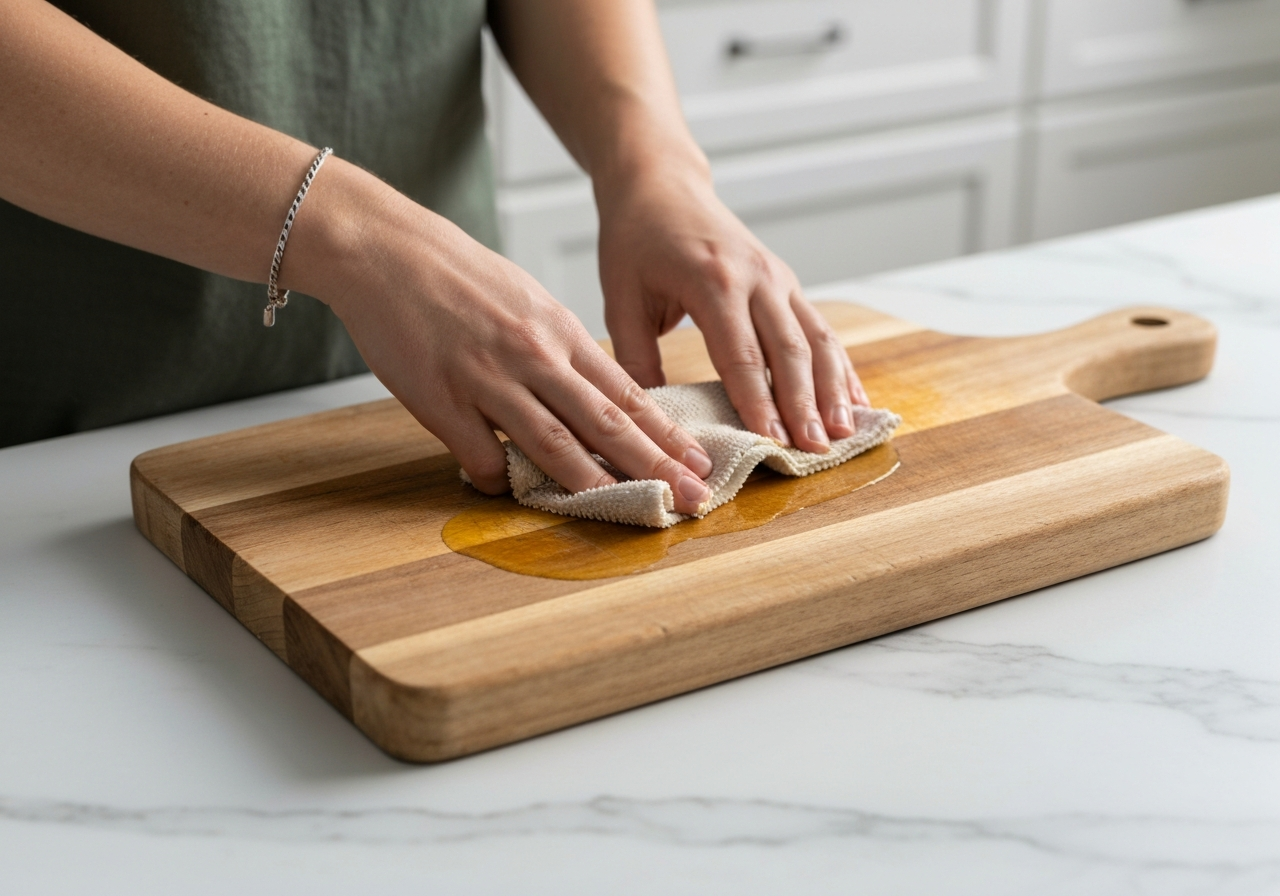
How to oil a wooden board
Frequency
- New board: once a week for the first month
- Frequent use: once a month
- Occasional use: every 2 to 3 months
Step by step
- Clean and dry board
- Oil the surface
- Spread with a cloth or paper towel
- Focus on the edges and corners
- Let it soak for at least 6 hours, ideally overnight
- Wipe off excess
The wood needs to be nourished, not soaked.
Stains, odors, knife marks: what to do?
Food stains
- Baking soda + water paste
- Rub gently
- Rinse and dry
Stubborn odors (garlic, onion, fish)
- Lemon + salt
- Or diluted white vinegar
Knife cuts
It's normal. Wood is made to be scratched.
If the surface is too deeply grooved:
- Light sanding with 180 then 240 grit paper
- Cleaning
- Complete oiling
A solid wood board can be restored several times in its life.
Storage: the detail that makes the difference
A low-end board, even if well-maintained, can deteriorate... due to storage.
Best practices
- Vertical storage
- Dry and airy place
- Never in a moldy cupboard
Avoid stacks that suffocate the wood.
And for artisanal or high-end boards?
Artisanal solid wood boards (oak, walnut, beech, maple) are in the spotlight.
They are:
- thicker
- made of selected wood
- designed for life
Regular maintenance allows them to:
- maintain their balance
- preserve their beauty
- highlight the artisan's work
Solid wood vs other materials: a sustainable choice
Unlike plastic or glass boards:
- wood does not release microplastics
- it is repairable
- it is part of a sustainable and responsible approach
Taking care of a wooden board also means opting for a more responsible kitchen.
In short: key takeaways
- Wash with lukewarm water and mild soap
- Dry immediately
- Disinfect naturally
- Oil frequently
- Never put in the dishwasher
- Store in a dry place
Conclusion
A well-maintained solid wood cutting board is a loyal, healthy and durable kitchen ally. With a few simple steps and natural products, you can extend its lifespan while maintaining its appearance and hygiene.
Maintaining your board means maintaining your kitchen, your utensils... and your enjoyment of cooking.


